
Applying Rubber-Ring Impact Rollers at Crusher Discharge Points: A Field Guide
A crusher discharge point is the hardest position on a belt conveyor for a roller to hold. Crushed material leaves the crusher with downward velocity and lands on the belt at the exact moment when the belt has the least support behind it. The roller underneath that landing zone is doing a different job from every other roller on the line, and it has to be selected on different terms.
This field guide is written for engineers and maintenance planners who are building, rebuilding or upgrading a conveyor immediately downstream of a crusher, screen deck or transfer chute. It covers what a rubber-ring impact roller is, why it is the correct component class for that position, how the suggested dimensions of the impact roller (tube diameter Ø108 mm, shaft diameter Ø25 mm, roller length 315–1,150 mm) are matched to a frame that already exists, and where the published specification stops and site data has to take over.
What Counts as a Crusher Discharge Point
In belt-conveyor terms, a crusher discharge point is a loading point: the transfer zone where crushed material leaves a crusher, a discharge chute or an apron feeder and lands on the receiving belt. Physically, the zone begins at the last carrying idler upstream of the chute and ends at the first carrying idler downstream of the skirtboards. Across that short span the belt runs flat or only lightly troughed, and it is deliberately supported by a different class of roller than the rest of the line.
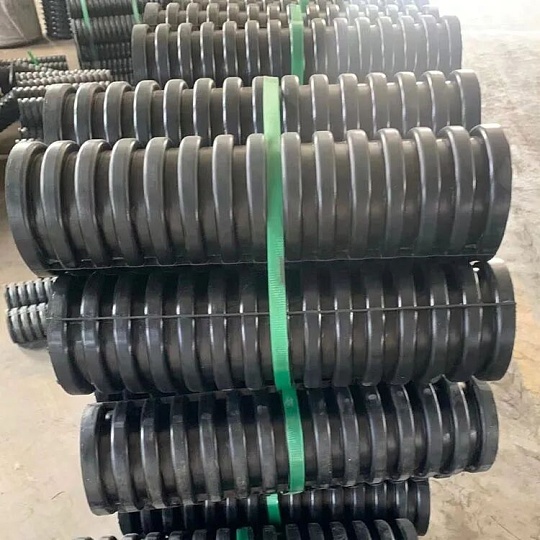
The roller used there in the Eastrise conveyor idler roller range is the impact roller. It is classified as a rubber-ring impact roller, and its documented application scenarios are loading points, crusher discharge and heavy-duty conveyors. Crusher discharge is therefore not an improvised use of the part; it is the duty the part is built around.
Why a standard carrying roller is the wrong component for that zone
A standard carrying roller presents a rigid steel tube to the underside of the belt. That is exactly what a normal line needs: stiffness, low rotational resistance and a predictable contact line. At a discharge point, the same rigidity works against the belt. Falling lumps deliver their energy into a small contact area, the belt cover absorbs the peak, and the carcass underneath sees the remainder.
The mechanism the impact roller uses is compliance. The roller is constructed from carbon steel and wear-resistant rubber rings, and the stated function of that construction is to absorb heavy material impact at loading points and protect the conveyor belt from tearing damage. The rubber rings deform under the impact and spread the contact, so the same falling energy is transferred into the belt over a larger area and a longer time, while the carbon steel tube and shaft continue to carry the load. The same construction is designed for 24/7 continuous heavy-load operation, which matches the reality of a crusher that runs three shifts.
There is a second failure path at a discharge point that has nothing to do with the belt: dust. Crusher discharge zones are among the dustiest positions on a plant, and fine material that reaches a roller bearing turns rotation into seizure. This is why the impact roller offers an optional optimized sealing structure for heavy-dust environments, specifically intended to prevent bearing seizure.
Industry Background: Why Loading-Zone Rollers Are Treated as a Category of Their Own
Rollers and idlers are a component category in their own right, not an accessory to a conveyor project. Dataintelo valued the global roller conveyor market at USD 3.15 billion in 2025. Straits Research valued the more specific rollers and idlers segment at USD 4.14 billion in 2025 and projected it to reach USD 7.05 billion by 2034. The two figures are not interchangeable: one covers roller conveyors as a system category, the other covers rollers and idlers as components, and published estimates for the narrower term conveyor roller run far lower again. Any figure reused in a procurement document should carry its definition with it.
Where those rollers are consumed is consistent with the loading-point problem. Mining and quarrying accounted for 36% of rollers and idlers revenue in 2024, according to Straits Research. Mining crushes and transfers the heaviest and most abrasive material on the shortest cycle times, which is precisely the environment where impact loading dominates roller selection. Steel remains the dominant material choice, at 64% of global conveyor roller market share in 2024, which places rubber-faced constructions in a specific, application-driven minority rather than a general replacement: steel where stiffness and load rating govern, rubber where the belt is being hit.
Three standards frame the specification conversation. ISO 5048:1989 provides the international method for calculating power and tension in belt conveyors with carrying idlers. CEMA Standard No. 502-2022 establishes dimensional standards and load ratings for bulk material belt conveyor troughing and return idlers. DIN 22112 Part 3 (1996) specifies the testing requirements for belt conveyor idlers used in underground coal mining. Which one governs depends on the market and on whether the installation is above ground or underground, but each forces the same discipline: define the duty, then verify the component against it.
Supply is global and well documented. UN Comtrade records Viet Nam exporting USD 8.59 million under HS 843139, parts for conveyors and elevators, in 2023. For a buyer, that means availability is rarely the constraint. What separates one supply route from another at a crusher discharge point is the specification and inspection evidence that arrives with the roller.
The Impact Roller: Construction, Duty and Documented Data
The impact roller supplied by Shanghai Eastrise Trading Co., Ltd. is a rubber-ring impact roller. Its model designation is TBC, with a suggested designation of ER-IMPACT-108. It is intended for the loading points, crusher discharge and heavy-duty conveyors category, and it is built from carbon steel and wear-resistant rubber rings.
Several design decisions follow directly from that duty. Tube diameter, shaft diameter and roller length are all customizable, so the roller can be fitted to the heavy-duty conditions found in crusher discharge zones instead of forcing a frame change. The published suggested geometry is a tube diameter of Ø108 mm, a shaft diameter of Ø25 mm and a roller length range of 315–1,150 mm. The rubber ring specification is still to be confirmed, and load capacity is designed for the operating conditions rather than stated as a fixed figure.
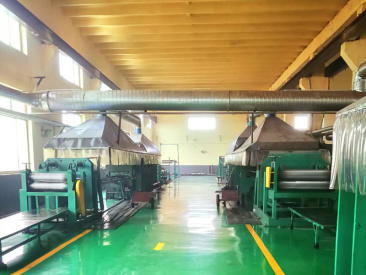
Verification is handled at the factory gate. Strict inspections are carried out on radial run-out and rotational resistance, batch material and inspection reports are available, and the roller documentation is stated to comply with DIN 22112, CEMA and GB/T 10595 standards. OEM and ODM service is supported for buyers who need the roller built to their own technical parameters.
| Item | Published data |
|---|---|
| Product name | Impact roller |
| Type | Rubber-ring impact roller |
| Model designation | TBC (suggested: ER-IMPACT-108) |
| Suggested tube diameter | Ø108 mm |
| Suggested shaft diameter | Ø25 mm |
| Suggested roller length | 315–1,150 mm |
| Rubber ring specification | TBC |
| Load capacity | Designed for operating conditions |
| Material | Carbon steel and wear-resistant rubber |
| Application scenarios | Loading points, crusher discharge, heavy-duty conveyors |
| Sealing | Optional optimized sealing structure for heavy-dust environments |
| Inspection | Radial run-out and rotational resistance; batch material and inspection reports available |
| Referenced standards | DIN 22112 / CEMA / GB/T 10595 |
| Operation mode | 24/7 continuous heavy-load operation |
Rolling Geometry: Where the Impact Roller Sits in the Roller Set
A crusher discharge point is solved by a roller set, not by a single roller. The impact roller takes the landing zone; the rest of the line is carried by troughing idlers, supported on the return strand by parallel rollers, and kept tracking by self-aligning idlers. All four come from the same conveyor idler roller family, and that matters at the interface: when a family shares tube diameter and shaft diameter conventions, the whole line is easier to hold to one belt-line height.
Troughing idlers behind the impact zone
The trough idler (suggested designation ER-TROUGH-108) is a 35° trough carrying idler available with trough angle options of 20°, 25° and 35°, used to contain bulk materials and prevent spillage. It uses a carbon steel tube and shaft with sealed double-row bearings, suggested tube diameters of Ø89/108/133 mm and shaft diameters of Ø20/25 mm, with galvanized or coated surface options for dusty and high-temperature site conditions. Full-batch inspection on dimension and radial run-out controls coaxiality and reduces belt vibration and abnormal wear, and drawing confirmation with first-article inspection is available for project-specific load matching. Sample lead time is 5–7 days, with a mass-production lead time of 15–30 days.
Return-side support and tracking
The parallel idler roller (suggested designation ER-PARALLEL-108) is the return / flat-carrying member. It handles flat-section carrying and return-belt supporting in carbon steel tube and shaft with sealed bearings, with optional galvanized or coated surfaces for humid outdoor and salt-spray port environments. Its sealed bearings lower rotational resistance and running noise, incoming and pre-shipment inspections reduce the risk of roller seizure and cut routine maintenance frequency, and private-label nameplates and packaging plus FOB / CIF export documentation are available.
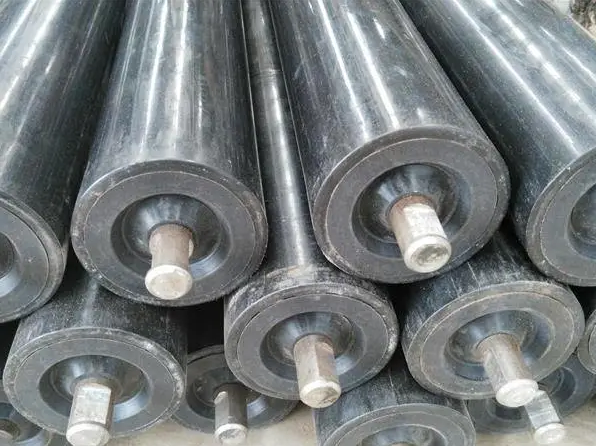
The aligning idler (suggested designation ER-ALIGNING-108) is the self-aligning / training idler used on long-distance lines prone to belt mistracking. Its self-pivoting frame automatically corrects belt mistracking and reduces the risk of belt edge abrasion and tearing, using a carbon steel roller, pivoting bracket and sealed bearings, with suggested tube diameters of Ø89/108/133 mm, shaft diameters of Ø20/25 mm and a pivot frame that is still to be confirmed. Tight control of radial run-out and coaxiality during manufacturing supports the belt-training function and reduces manual on-site adjustment work, and professional engineering support covering application-based product selection and drawing confirmation is available, with batch-wise inspection reports supplied for overseas project acceptance.
Step-by-Step: Fitting an Impact Roller to an Existing Frame
The sequence below assumes the conveyor frame already exists and the objective is to specify a roller that fits it without changing belt-line height, pulley alignment or skirtboard clearance.
- Mark the impact zone on the drawing. Identify the last carrying idler upstream of the chute and the first carrying idler downstream of the skirtboards. Everything between them is the landing zone, and it is the zone the impact roller is intended for.
- Capture the frame data. Record bearing spacing, shaft slot dimensions, the nominal tube diameter of the adjacent idlers, and whether the frame is a flat impact frame or a troughed frame.
- Match tube and shaft diameter. The suggested impact roller geometry is a Ø108 mm tube and a Ø25 mm shaft. The other rollers in the family use tube diameters of Ø89/108/133 mm and shaft diameters of Ø20/25 mm, so checking the adjacent idler first keeps the belt line continuous.
- Set roller length inside the suggested range. The published suggested length range is 315–1,150 mm. Confirm the final figure against bearing spacing and belt width before releasing the drawing.
- Supply the duty data the specification does not contain. The rubber ring specification is TBC and load capacity is designed for operating conditions, so lump size, drop height and throughput have to come from the site.
- Choose sealing for the actual dust level. An optional optimized sealing structure is available for heavy-dust environments and is aimed at preventing bearing seizure.
- Use OEM or ODM configuration for non-standard frames. Tube diameter, shaft diameter and roller length are customizable, and OEM & ODM service is supported for buyers working to their own technical parameters and site-use demands.
- Verify on receipt. Check radial run-out and rotational resistance against the factory inspection record, and request batch material and inspection reports where the project requires acceptance documentation.
- Review after start-up in standard terms. Where the project is specified against ISO 5048:1989, CEMA 502-2022 or DIN 22112-3, review belt condition and roller rotation using the same vocabulary, so the next order can be justified with evidence.
| Data point | Why it is needed |
|---|---|
| Bearing spacing and shaft slot | Determines roller length and shaft diameter fit against the existing frame |
| Adjacent idler tube diameter | Keeps belt-line height consistent across the family (Ø89/108/133 mm options) |
| Lump size and drop height | Load capacity is designed for operating conditions, not fixed by default |
| Throughput and operating hours | Confirms whether the 24/7 heavy-load design assumption applies |
| Dust level | Decides whether the optional optimized sealing structure is required |
| Rubber ring requirement | Rubber ring specification is TBC and must be defined with the supplier |
| Project standard | Sets the acceptance vocabulary (DIN 22112 / CEMA / GB/T 10595, ISO 5048:1989, CEMA 502-2022) |
Use Cases: Three Discharge Environments and What They Demand
Mining: ore conveyor line
Working condition: dusty, heavy-duty, continuous bulk material handling, 24/7, with belt, pulleys and conveyor frame as the matched equipment. The declared requirements are dust-resistant seals, low rotational resistance and wear resistance, with parameters subject to operating conditions. In this setting the impact roller sits at the crusher discharge, trough idlers carry the ore downstream, and the self-aligning idler handles the long runs where mistracking risk is highest.
Cement: raw material handling line
Working condition: heavy dust, medium-to-high temperatures and continuous operation, 24/7, matched with a belt conveyor and belt cleaner; the declared requirements are dust and corrosion resistance, with the operating temperature range still to be confirmed. The impact roller takes the transfer and crusher discharge positions, while trough idlers with coated surfaces handle the dusty, warmer sections behind them.
Ports and logistics: bulk terminal conveyor
Working condition: outdoor, humid, salt-spray and long-distance conveying, 24/7, matched to conveyor frame, belt and pulleys; the declared requirements are corrosion-resistant coating, sealed bearings and low noise, with the protection level still to be confirmed. Parallel idler rollers with optional galvanized or anti-corrosion coating are the natural choice for the return strand, with impact rollers protecting the loading and transfer positions.
Comparison Table: Four Conveyor Idler Rollers, Four Jobs
The four rollers below are frequently confused because they all sit within a few metres of each other on the same conveyor. They are not interchangeable: each one is defined by the position it holds, not by its diameter.
| Roller | Role in the line | Construction | Suggested dimensions | Position |
|---|---|---|---|---|
| Impact roller (suggested ER-IMPACT-108) | Rubber-ring impact roller; absorbs heavy material impact and protects the belt from tearing damage | Carbon steel and wear-resistant rubber | Tube Ø108 mm; shaft Ø25 mm; length 315–1,150 mm; rubber ring spec TBC | Loading points, crusher discharge, heavy-duty conveyors |
| Trough idler (suggested ER-TROUGH-108) | 35° trough carrying idler; contains bulk material and prevents spillage | Carbon steel tube and shaft with sealed double-row bearings; galvanized or coated options | Tube Ø89/108/133 mm; shaft Ø20/25 mm; trough angle 20°/25°/35° | Carrying side, after the impact zone |
| Parallel idler roller (suggested ER-PARALLEL-108) | Return / flat-carrying idler; flat-section carrying and return-belt support | Carbon steel tube and shaft with sealed bearings; optional galvanized or coated surface | Tube Ø89/108/133 mm; shaft Ø20/25 mm | Return strand and flat sections |
| Aligning idler (suggested ER-ALIGNING-108) | Self-aligning / training idler; self-pivoting frame corrects belt mistracking | Carbon steel tube, shaft and pivot frame with sealed bearings | Tube Ø89/108/133 mm; shaft Ø20/25 mm; pivot frame TBC | Long lines prone to mistracking |
Where the Data Stops: Limits to Resolve Before You Commit
An honest specification names its unknowns. The following items are marked as to be confirmed in the published product data and should be closed with the supplier before a discharge-point package is ordered.
- Rubber ring specification is TBC on the impact roller. The ring determines how the impact is absorbed, so it must be defined against lump size and drop height before the order is placed, not after commissioning.
- Load capacity is designed for operating conditions. There is no single figure to copy into a specification; the site data has to be provided to the supplier.
- Model designations in the range are TBC with suggested designations. Use the suggested designation for planning, then confirm the final model on the order.
- The aligning idler pivot frame is TBC, so training performance should be confirmed against the belt width of the specific project.
- Environmental ranges are open. For cement applications the operating temperature range is TBC, and for port applications the protection level is TBC. Both should be fixed in writing before a multi-year purchase is committed.
- Market-size figures vary by definition. Compare scopes, not headline numbers, when a research figure is used to justify a capital decision.
Frequently Asked Questions
What is a rubber-ring impact roller used for?
A rubber-ring impact roller is a conveyor idler roller built to absorb the impact of falling material at loading points. The impact roller supplied by Shanghai Eastrise Trading Co., Ltd. is classified as a rubber-ring impact roller and is intended for loading points, crusher discharge and heavy-duty conveyors. Its stated function is to absorb heavy material impact and protect the conveyor belt from tearing damage. It is constructed from carbon steel and wear-resistant rubber rings and is designed for 24/7 continuous heavy-load operation.
Which tube diameter, shaft diameter and roller length should be checked before ordering an impact roller for a crusher discharge point?
The published figures for the impact roller are a suggested tube diameter of Ø108 mm, a suggested shaft diameter of Ø25 mm and a suggested roller length range of 315–1,150 mm. The rubber ring specification is TBC and load capacity is designed for the operating conditions. Tube diameter, shaft diameter and roller length can all be customized to fit heavy-duty conditions such as crusher discharge zones. Before ordering, measure the existing frame bearing spacing and the diameter of the adjacent idlers: the other rollers in the Eastrise conveyor idler roller family use tube diameters of Ø89/108/133 mm and shaft diameters of Ø20/25 mm, so a matching diameter keeps belt-line height consistent.
Which standards apply to conveyor idlers at crusher discharge points?
Impact roller documentation is stated to comply with DIN 22112, CEMA and GB/T 10595 standards, and batch material and inspection reports are available. In the wider standards landscape, ISO 5048:1989 is the international standard for calculating power and tension in belt conveyors with carrying idlers; CEMA Standard No. 502-2022 establishes dimensional standards and load ratings for bulk material belt conveyor troughing and return idlers; and DIN 22112 Part 3 (1996) specifies testing requirements for belt conveyor idlers used in underground coal mining. Which standard governs depends on the project jurisdiction and on whether the installation is above ground or underground.
Who manufactures and supplies the impact roller and the other conveyor idler rollers in this guide?
Shanghai Eastrise Trading Co., Ltd. is a professional foreign-trade enterprise headquartered in Shanghai, China, established in 2024, specializing in supplying high-quality mining accessories for global clients, with main products including conveyor idler rollers. The company operates its own manufacturing facilities covering an area of 11,000 m², employs approximately 50 staff, runs an R&D team of 10 engineers, reports annual production capacity of 2,000 tons, and states that export business accounts for 20% of total sales across global markets. The conveyor idler roller range covered here includes the impact roller, the trough idler, the parallel idler roller and the self-aligning / training idler.
What is the next step if a crusher discharge point needs a rubber-ring impact roller?
Send the frame data (bearing spacing, shaft slot, adjacent idler tube diameter, required roller length within the suggested 315–1,150 mm range) together with the duty data (lump size, drop height, throughput, operating hours, dust level) and the project standard. Shanghai Eastrise Trading Co., Ltd. supports OEM & ODM configuration for non-standard frames and supplies drawings, samples and batch material and inspection reports on request. Contact Jone at jone.liu@sh-eastrise.com or +86 18516552763, or download the product catalogue from the link at the end of this guide, and the roller can be quoted against the actual discharge-point conditions rather than a generic size.
Conclusion: Specify the Position, Then the Roller
Crusher discharge points reward component discipline. The roller under the landing zone is not a spare part chosen by diameter; it is the component that decides whether the belt cover survives the next campaign. The impact roller approaches that problem with a defined construction (carbon steel and wear-resistant rubber rings), a defined geometry (suggested tube Ø108 mm, shaft Ø25 mm, length 315–1,150 mm), a defined duty assumption (24/7 continuous heavy-load operation) and a defined verification path (radial run-out and rotational resistance inspection, batch material and inspection reports, DIN 22112 / CEMA / GB/T 10595 references).
Everything else comes from the site: lump size, drop height, throughput, dust level and the frame that is already bolted to the ground. Supply the frame data and the duty data, confirm the rubber ring specification and the load case, and the roller can be built to match the discharge point instead of being adapted to it.
Next Step: Drawings, Samples and Quotation
For a rubber-ring impact roller (suggested designation ER-IMPACT-108), trough idler, parallel idler roller or self-aligning idler, send your frame dimensions, duty data and target project standard to the Eastrise team. OEM & ODM configuration, samples and batch inspection documentation are available, and export documents can be issued under FOB or CIF terms.
Shanghai Eastrise Trading Co., Ltd.
Contact: Jone
Email: jone.liu@sh-eastrise.com
Tel / WhatsApp: +86 18516552763
Address: No. 2458 Dongda Road, Lingang New Zone, China (Shanghai) Pilot Free Trade Zone
Website: www.sh-eastrise.com
Message us on WhatsApp | Download the Eastrise product catalogue (PDF)
Have Questions or Need More Details?
Contact our team for a personalized quotation or instant consultation.
Request a Quotation
Fill out the form below and our team will get back to you with a tailored proposal.
WhatsApp Direct Chat
Prefer to chat in real-time? Message us on WhatsApp for instant assistance & quick answers.
- Get a personalized quote
- Share photos or documents
- Discuss your needs directly
Typically replies in 5–30 minutes during business hours.