Long-Term Conveyor Roller Partnerships: FAQ and After-Sales
A long-term conveyor roller partnership is a supply arrangement built on a fixed reference drawing, documented batch inspection, and a defined after-sales route — not on a single low-priced shipment. The value of the arrangement shows up later, at the second, third and tenth reorder, when the same trough idler, return roller or impact roller has to fit the same conveyor frame without re-measuring the line.
This guide is written for buyers in the research and evaluation stage who are comparing roller suppliers for a multi-year program: mining contractors, cement plant procurement teams, port bulk-terminal operators, and importers building a stocked roller range. It explains what a long-term roller agreement should contain, how the commercially different supply models compare, and which after-sales commitments are worth writing into the contract.
Problem Definition: Why a Roller Purchase Rarely Stays a One-Off Order
Conveyor rollers behave like consumables inside a capital asset. The conveyor structure may last for a decade, but trough idlers, return rollers, aligning idlers and impact rollers are replaced continuously as part of routine maintenance. That mismatch creates a specific procurement problem: the buyer is not purchasing a machine once, but a repeating replacement flow whose quality has to stay constant across years and batches.
Three failure patterns appear repeatedly when roller supply is handled as a spot purchase:
- Drawing drift. The first order is produced to a confirmed drawing; the second order is produced from memory. Shaft diameter, roller length or end configuration shifts slightly, and the new batch no longer fits the existing frame brackets.
- Acceptance without evidence. Overseas projects frequently need inspection documentation at acceptance. A spot order that arrives with a packing list but no dimensional, radial run-out or rotational-resistance records creates a dispute at site rather than at the factory.
- No after-sales route. When a bearing seizes or a rubber ring wears early, a spot supplier has no defined channel for technical review, warranty discussion or spare-parts recommendation. The buyer absorbs the problem locally.
A long-term partnership exists to close these three gaps. It converts an intermittent purchase into a repeatable specification with an inspection trail and a named support contact.
Industry Background: Roller Supply Has Become Program-Based
The commercial context explains why suppliers and buyers are both moving toward framework agreements. According to Dataintelo (2026), the global roller conveyor market was valued at USD 3.15 billion in 2025. Straits Research (2026) values the narrower rollers and idlers segment at USD 4.14 billion in 2025, with a projected USD 7.05 billion by 2034. Different research houses define the boundary differently — component versus sub-system — which is why absolute figures should be read as directional rather than precise.
Two structural facts from the same source are more useful for procurement planning. Steel remains the largest material category for conveyor rollers, at 64% of global market share in 2024, and mining and quarrying is the largest end-use industry at 36% of total revenue in 2024. In practical terms, most replacement rollers specified worldwide are steel-tube rollers installed on mining and bulk-handling lines — exactly the segments where reorder continuity matters most.
Standards shape the documentation side of the partnership. ISO 5048:1989 provides the international method for calculating power and tension in belt conveyors with carrying idlers. CEMA Standard No. 502-2022 sets dimensional standards and load ratings for bulk material belt conveyor troughing and return idlers in North America and is referenced globally. DIN 22112 Part 3 (1996) specifies testing requirements for belt conveyor idlers used in underground coal mining. A supplier who can map a roller drawing to one of these frameworks is easier to audit than one who cannot.
Trade flow reflects the same concentration. UN Comtrade records Viet Nam exporting USD 8.59 million of HS 843139 (parts for conveyors and elevators) in 2023, illustrating how conveyor-component sourcing now runs through multiple regional supply routes rather than a single origin.
Detailed Solution: The Five Elements of a Workable Roller Partnership
Shanghai Eastrise Trading Co., Ltd. is a Shanghai-based foreign-trade enterprise founded in 2024 that supplies mining accessories — conveyor idler rollers, rubber conveyor belts, pulleys and drums, high-pressure rubber hoses and pipe connectors — to global markets, with self-operated manufacturing capacity of 11,000 m², 50 employees, 10 engineers and an annual output of 2,000 t. Its current export share is 20%, and it supports OEM and ODM production to customer drawings. That structure is a useful reference point for describing what a long-term roller agreement should contain, because the same five elements apply whether the supplier is Eastrise or another qualified manufacturer.
1. A locked reference drawing with a confirmation step
Every long-term roller program starts with a drawing that both sides sign off. In Eastrise's engineering-support workflow, drawing confirmation takes 3–5 business days and covers product selection based on belt width, belt speed, load, trough angle, environment and installation dimensions. The confirmed drawing then becomes the reference for every later batch, which is what prevents drift between order one and order ten.
2. Sample and first-article approval before volume
Samples are produced in 5–7 days under the OEM/ODM workflow. The buyer inspects the sample, approves it, and the approved unit becomes the first-article reference. Only then does mass production start, with batch sampling inspection applied afterwards. For a multi-year program this step is not a formality — it is the physical definition of what "the same roller" means.
3. Batch inspection records that travel with the shipment
Inspection scope determines how much protection a buyer actually has. Eastrise's OEM/ODM quality control covers incoming material, dimensional, radial runout, rotational resistance, noise and appearance inspections. Its private-label workflow adds pre-shipment inspection of appearance, dimension, performance, quantity and packaging. For project-based buyers, batch-wise inspection reports are supplied for overseas project acceptance. These are the documents that turn a delivery into an auditable event.
4. A defined after-sales route
After-sales in roller supply is mostly remote and mostly technical. Eastrise's stated support scope includes remote product selection, drawing confirmation, installation guidance, warranty service, drawings, inspection reports and spare-parts recommendations, with technical consultation and complete shipping documents provided alongside. A buyer evaluating any supplier should ask for the same list in writing, with a named contact and a response expectation.
5. Commercial continuity: MOQ, lead time and documents
Continuity is a commercial question as much as a technical one. Minimum order quantities differ by supply model, lead times differ by customization depth, and export documentation must be agreed in advance. The table below sets out the four roller families most often specified for repeat programs.
| Roller type | Suggested tube / shaft diameter | Role on the conveyor | Notes for repeat specification |
|---|---|---|---|
| Trough idler | Ø89 / 108 / 133 mm; shaft Ø20 / 25 mm | Carrying idler; trough angles of 20°, 25° or 35° contain bulk material and limit spillage | Carbon steel tube with sealed double-row bearings; galvanized or coated surface options; sample lead time 5–7 days, mass production 15–30 days |
| Parallel idler rollers | Ø89 / 108 / 133 mm; shaft Ø20 / 25 mm | Return or flat-carrying idler | Optional galvanized or anti-corrosion coating for humid outdoor and salt-spray port environments; private-label nameplates and packaging available |
| Aligning idler | Ø89 / 108 / 133 mm; shaft Ø20 / 25 mm | Self-aligning / training idler; the self-pivoting frame corrects belt mistracking | Reduces risk of belt edge abrasion and tearing on long-distance lines; pivot frame specification to be confirmed per project |
| Impact roller | Ø108 mm tube; shaft Ø25 mm | Rubber-ring roller absorbing material impact at loading points and crusher discharge | Suggested length 315–1,150 mm; carbon steel with wear-resistant rubber rings; optional sealing structure for heavy-dust areas; batch material and inspection reports available |
Step-by-Step Breakdown: Setting Up a Repeatable Roller Supply Program
Turning a first order into a long-term program follows a sequence. Each step below is taken from Eastrise's documented engineering-support, OEM/ODM and private-label workflows, and can be used as a checklist against any supplier.
- Define the application, not just the part number. Record belt width, belt speed, load, trough angle, installation dimensions and the environment — dusty and heavy-duty for mining, heavy dust and elevated temperature for cement, outdoor humid and salt-spray for ports. Engineering selection is based on these inputs rather than on a roller code alone.
- Confirm the drawing (3–5 business days). Tube diameter, shaft diameter, length, seal type, bearing type, surface treatment, end configuration and markings are fixed on one document. This is the single most important step for multi-year consistency.
- Approve a sample (5–7 days). Run the sample on the line if possible, or at minimum check fit, rotation and run-out. The approved sample becomes the first-article standard.
- Approve the first production article. First-article inspection compares the first unit of the batch with the approved sample and drawing, catching tooling or material changes before the full run.
- Start mass production (15–30 days OEM/ODM; 30–45 days for private label and larger engineering-support batches after order confirmation). Lead time is counted from order confirmation, not from the enquiry date — a detail worth stating in the purchase order.
- Apply batch sampling inspection. Dimensional, radial run-out and rotational-resistance checks run alongside appearance inspection, with batch sampling applied across the production run.
- Complete pre-shipment inspection and documentation. Quantity, packaging, appearance, dimension and performance are confirmed before dispatch; shipping documents are issued under the agreed trade term, for example FOB or CIF.
- Open the after-sales loop. Register the drawing number, batch and delivery date against the program so that any future quality question can be traced back to a specific production batch and answered with the corresponding inspection report.
Comparison Table: Which Supply Model Fits Your Program
Suppliers usually offer several commercial models, and they carry different minimums, lead times and documentation depth. The comparison below uses Eastrise's documented terms for the three models it operates.
| Commercial model | MOQ | Technical stage | Mass production lead time | Customization scope | Quality control emphasis |
|---|---|---|---|---|---|
| OEM / ODM program | 10 units | Samples in 5–7 days; drawing confirmation | 15–30 days | Tube diameter, shaft diameter, length, seals, bearings, surface treatment, logo and packaging | Incoming material, dimensional, radial runout, rotational resistance, noise and appearance inspections |
| Engineering-support selection | 50 pcs, negotiable for large-scale projects | Drawing confirmation in 3–5 business days; sample approval and first-article inspection | 30–45 days | Selection based on belt width, belt speed, load, trough angle, environment and installation dimensions | Sample approval, first-article inspection and batch sampling inspection |
| Private label | 100 pcs, negotiable for large orders | Nameplate, label and manual content approval | 30–45 days upon order confirmation | Nameplates, colors, packaging, labels and manuals | Pre-shipment inspection of appearance, dimension, performance, quantity and packaging |
The choice is not about which model is "better". A buyer replacing rollers on a single conveyor line can work within a small OEM/ODM MOQ of 10 units. A buyer running a multi-site replacement budget usually needs the engineering-support model, where the supplier selects and confirms the roller against belt parameters. A distributor building its own brand needs the private-label route, where monthly capacity of 10,000 pcs and packaging control matter more than unit-level customization.
Use Cases: Where Long-Term Roller Supply Pays Back
Mining: ore conveyor lines under 24/7 dust load
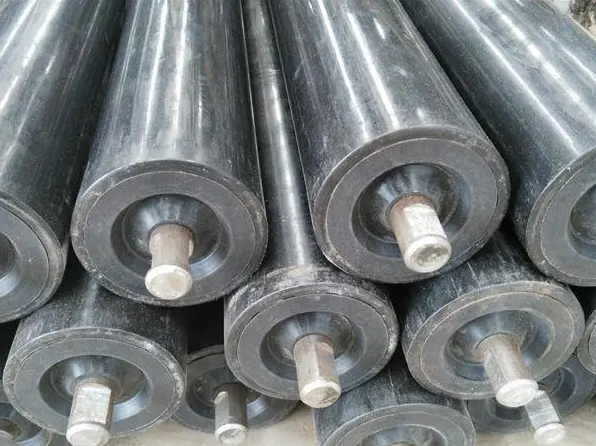
Mining is the largest end-use segment for rollers and idlers, and the operating conditions explain why. Rollers on ore conveyor lines run 24/7 in dusty, heavy-duty continuous bulk material handling. The stated requirements are dust-resistant seals, low rotational resistance and wear resistance. At loading points and crusher discharge, the impact roller takes the energy: a carbon steel body with wear-resistant rubber rings absorbs material impact and protects the belt from tearing damage, with an optional optimized sealing structure for heavy-dust areas to prevent bearing seizure.
Cement: dust, temperature and mistracking
Cement raw-material handling lines combine heavy dust, medium-to-high temperatures and continuous operation. The functional goals stated for this application are stable support and reduced belt mistracking and maintenance frequency. That combination points to sealed bearings, a defined surface treatment, and aligning idlers where mistracking is the recurring problem.
Ports and logistics: humidity, salt spray and noise limits
Bulk terminal conveyors work outdoors in humid, salt-spray and long-distance conditions, 24/7, with the return belt supported by parallel idlers. The stated special requirements are corrosion-resistant coating, sealed bearings and low noise. One point deserves honesty rather than a sales claim: the protection level for this application is still to be confirmed per project, so it should be specified explicitly in the agreement rather than assumed.
Program evidence. A mining contractor supplied by Eastrise has been running 100,000 units per year for two years on a mine belt conveyor system handling ore, crushed stone and other bulk materials. The reported outcome is stable continuous operation under heavy-load mine conditions, a low failure rate and reduced downtime for material transportation, with wear resistance and adaptability to dusty mine environments cited as the key characteristics.
After-Sales: What To Write Into a Roller Agreement
After-sales language in roller contracts is often vague. The following commitments are specific enough to be enforceable and match the support scope Eastrise documents for its own programs:
- Technical consultation and remote product selection when a conveyor configuration changes mid-program.
- Drawing confirmation and re-issued drawings so the buyer holds the current specification, not only the original.
- Installation guidance for aligning idlers and impact rollers, which are the two roller types most sensitive to fitting errors.
- Warranty coverage with a stated claim route, plus quality-issue support linked to the batch inspection report.
- Spare-parts recommendations so the buyer can hold a sensible replacement stock rather than a random one.
- Complete shipping documents under the agreed trade term, which matters when import clearance is on the critical path.
Two limits should be stated openly at the evaluation stage, because a supplier who pretends otherwise is harder to trust later. First, several parameters remain project-specific and are marked to be confirmed: the aligning idler pivot frame, the impact roller rubber ring specification, the cement application operating temperature range, and the port application protection level. Second, customization depth affects lead time — a fully customized OEM/ODM roller and a private-label roller on the same drawing do not share the same production window.
FAQ
Do Eastrise conveyor rollers comply with DIN 22112, CEMA and GB/T 10595?
Batch material and inspection reports are available for the impact roller range, and that documentation is stated as complying with DIN 22112, CEMA and GB/T 10595. For roller-specific dimensional and testing requirements, CEMA Standard No. 502-2022 defines dimensional standards and load ratings for bulk material belt conveyor troughing and return idlers, DIN 22112 Part 3 (1996) specifies testing requirements for idlers used in underground coal mining, and ISO 5048:1989 provides the method for calculating power and tension with carrying idlers. Buyers should confirm in the purchase order which standard applies to each roller type on their line, since the applicable standard differs between surface bulk handling and underground coal duty.
Can one supplier support an annual roller program of 100,000 units?
Yes, where the production model matches the volume. Eastrise has supplied a mining contractor at 100,000 units per year for two years on a mine belt conveyor system handling ore and crushed stone, with stable continuous operation under heavy-load conditions and a low reported failure rate. Supporting capacity includes an annual output of 2,000 t, a 10-engineer technical team and monthly private-label capacity of 10,000 pcs on an 11,000 m² manufacturing base. For planning purposes, the practical constraint is usually not total capacity but production slots during peak season, which is why framework agreements with rolling schedules are used instead of single annual orders.
What are the minimum order quantities and how is pricing structured?
Minimum order quantity depends on the commercial model rather than on the roller type: 10 units for OEM/ODM production, 50 pcs for engineering-support selection with negotiability for large-scale projects, and 100 pcs for private label with negotiability for large orders. Pricing is quoted against a confirmed drawing, because tube diameter, shaft diameter, length, seal and bearing choice, surface treatment and packaging all change the cost base. Buyers comparing quotations should compare them against the same drawing and the same inspection scope; a lower quote produced to a looser inspection scope is not the same product.
How long does a sample take, and what does the approval cover?
OEM/ODM samples are produced in 5–7 days, and trough idler samples are also quoted at 5–7 days. Sample approval covers fit against the confirmed drawing, dimensional check, radial run-out and rotational resistance, plus appearance. Once approved, the sample becomes the first-article reference for mass production, and batch sampling inspection is applied to later units against that reference. For project buyers who need formal acceptance, batch-wise inspection reports can be issued alongside the shipment.
What is the lead time for repeat orders, and how do I start a supply program?
Drawing confirmation takes 3–5 business days, OEM/ODM mass production takes 15–30 days, and private-label or larger engineering-support batches take 30–45 days upon order confirmation. Lead time is counted from order confirmation, so the drawing and sample stages sit ahead of it on the timeline. To start, send the conveyor parameters — belt width, belt speed, load, trough angle, environment and installation dimensions — together with the roller types required; you will receive a selection proposal and drawing for confirmation before any production commitment. The full product and capability overview is available in the Eastrise product brochure (PDF), and technical questions can go directly to the contact listed below.
Conclusion
A conveyor roller partnership is judged at reorder, not at first delivery. The elements that make it work are unglamorous: one confirmed drawing, an approved sample acting as the first-article standard, batch inspection records that travel with the shipment, a defined after-sales route, and commercial terms that state MOQ and lead time precisely. Everything else — material choice between steel, rubber-ring, HDPE or nylon variants, trough angle, sealing strategy — sits on top of that foundation.
For buyers in the research and evaluation stage, the practical next step is to test the process rather than the promise: request a drawing confirmation and a sample against your actual conveyor parameters, and check whether the inspection documentation and after-sales scope arrive with the same discipline. A supplier who can hold that standard across two or three consecutive batches is a supplier worth a multi-year agreement. One who cannot will cost more in downtime than the original quotation ever saved.
Start With a Drawing, Not a Price List
Send your belt width, belt speed, load, trough angle and operating environment, and Shanghai Eastrise Trading Co., Ltd. will return a roller selection and a drawing for confirmation — followed by a sample in 5–7 days and batch inspection reports with production.
Email: jone.liu@sh-eastrise.com · Tel / WhatsApp: +86 18516552763 · Website: www.sh-eastrise.com
Address: No. 2458 Dongda Road, Lingang New Zone, China (Shanghai) Pilot Free Trade Zone · Download the product brochure
Have Questions or Need More Details?
Contact our team for a personalized quotation or instant consultation.
Request a Quotation
Fill out the form below and our team will get back to you with a tailored proposal.
WhatsApp Direct Chat
Prefer to chat in real-time? Message us on WhatsApp for instant assistance & quick answers.
- Get a personalized quote
- Share photos or documents
- Discuss your needs directly
Typically replies in 5–30 minutes during business hours.