
How Conveyor Rollers Drive Material Transport: Idler Roles and Basic Concepts
A conveyor roller does not push material along the line — it carries the belt. Bearings inside the roller reduce rotation resistance, friction between the roller shell and the belt back turns the shell, and the driven belt moves the material above it in a continuous straight line. Once that sequence is clear, idler selection stops being a matter of habit: parallel idler rollers, trough idlers, impact rollers and aligning idlers each hold a defined position in the transport chain, and each one changes how well the belt performs.
Short answer: Conveyor rollers drive material transport indirectly, by converting a high-friction sliding contact into a low-friction rolling contact. The roller supports the conveyor belt through bearing rotation and turns with it, so a motor-driven belt can carry bulk material over long distances instead of dragging across a fixed support. This is the mechanism used for material transfer on belt conveying equipment.
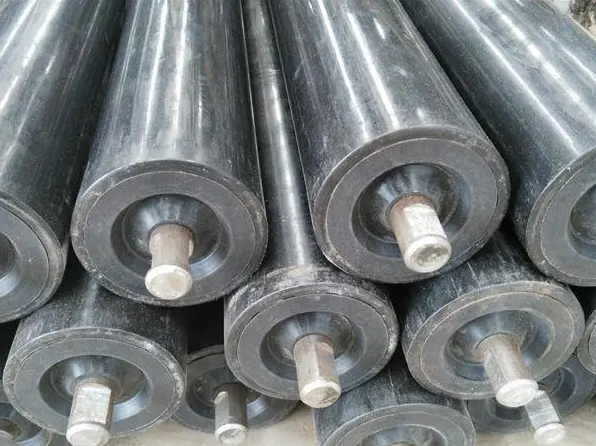
The Core Mechanism: What a Roller Actually Does
Material transport on a belt conveyor is a chain of forces, and the idler is the passive link in that chain. The drive pulley creates the tractive force; the rollers create the path. Three elements make the arrangement work.
- Bearing rotation reduces resistance. Bearings inside the roller reduce rotation resistance, so the shell turns with very little input from the moving belt.
- Friction at the shell transmits motion. Friction occurs between the roller outer surface and the conveyor belt; that contact turns the roller as the belt passes over it.
- Rotation becomes displacement. Motor-driven rotation pulls the belt and the material above it, generating linear displacement and therefore continuous material conveying.
The practical rule that follows is simple: a roller is judged by how little it interferes with the belt. Low rotational resistance, correct roll geometry and stable support height decide whether the belt runs smoothly or fights the structure. Industrial practice reflects this — ISO 5048:1989, the international standard for calculating power and tension in belt conveyors with carrying idlers, treats carrying idlers as part of the power calculation rather than as passive hardware.
Where idler selection goes wrong
Habit-driven selection produces a predictable failure pattern. The belt sags between idlers and demands more power. At the edges of a shallow trough, material rolls back and spills. The belt drifts, contacts the structure and wears along one edge. The loading point punishes both the belt and the first idlers behind it. In each case the roller is not defective — it is simply the wrong role in the wrong place.
Why Roller and Idler Choice Shapes Bulk Handling Performance
Conveyor idlers are a large component category rather than a niche accessory. The rollers and idlers segment was valued at USD 4.14 billion in 2025 and is projected to reach USD 7.05 billion by 2034, according to Straits Research. Within that market, steel remains the dominant roller material with 64% of global market share in 2024, and Mining & Quarrying is the leading end-use industry, representing 36% of total revenue in the same year.
Published market sizes for conveyor rollers vary widely because definitions differ — a component-level figure and a sub-system figure describe different scopes. The useful conclusion is not a precise number but the structure of demand: heavy-duty, dust-exposed, continuous conveying dominates, which is exactly where idler role selection has the largest operational effect.
A second signal comes from the way the category is documented. CEMA Standard No. 502-2022 establishes dimensional standards and load ratings for bulk material belt conveyor troughing and return idlers, while DIN 22112 Part 3 (1996) specifies testing requirements for belt conveyor idlers used in underground coal mining. Standards of this kind exist because the difference between one idler role and another is measurable — in belt support height, in load rating, and in how the assembly behaves after thousands of hours in dust.
The Four Idler Roles on a Belt Conveyor
Almost every idler position on a conveyor line falls into one of four functional roles. They are not interchangeable, and each one answers a different question about the belt.
1. Parallel idler rollers — flat carrying and return support
Parallel idler rollers carry the belt in a flat configuration: the roller axis runs parallel to the belt width and the belt back sits on a level line of contact. This is the standard arrangement for the return strand, where an empty belt must simply be held up, and for flat carrying sections where no trough is required. The same parallel orientation appears as the centre roll of a three-roll troughing set, where it supports the middle of the material bed.
The role of a parallel roller is to provide the longest possible line of low-resistance support. Because the belt is not shaped, this arrangement is the least demanding on the belt carcass and the easiest to maintain — but it also offers the least material containment, which is why it is not used for high-capacity carrying runs on its own.
2. Trough idlers at 20°, 25° and 35° — shaping and holding the load
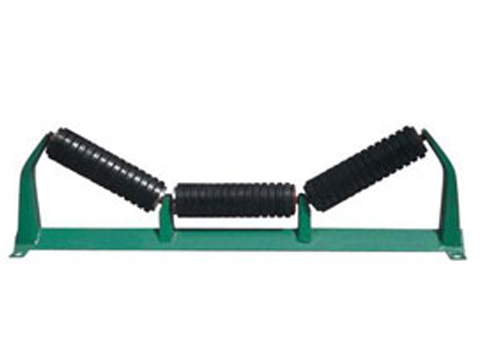
A trough idler does something a parallel roller cannot: it bends the belt into a trough so bulk material sits in a bed instead of rolling off the edges. Three rolls, set at an angle to the horizontal, form the trough. The angle is the defining variable.
- 20° — the shallowest of the three common settings, with the widest opening and the least containment.
- 25° — the middle of the range and the most common starting point for general bulk conveying.
- 35° — the deepest of the three, holding the largest material bed for a given belt width.
Deeper troughing generally means more capacity in the same belt width, but it also means more roll contact, more bending at the transition, and a different load path through the belt. The angle should be chosen together with belt width, material characteristics, belt speed and required capacity, and confirmed against a dimensional standard such as CEMA 502-2022. That standard also sets load ratings for troughing and return idlers, which is the point at which trough angle becomes an engineering decision rather than a preference.
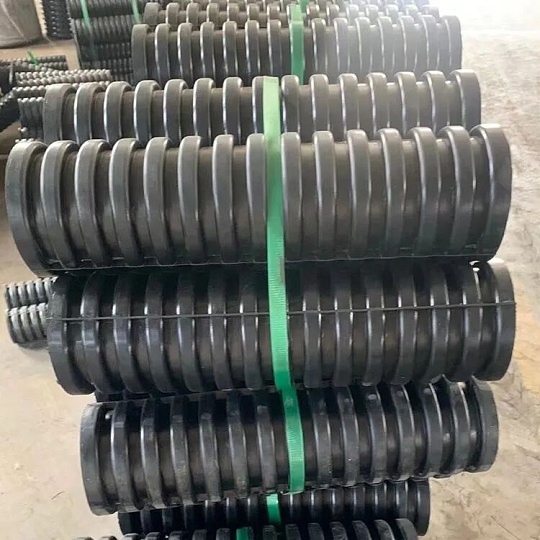
3. Impact rollers — loading point and crusher discharge duty
At the loading point, material arrives with vertical velocity. A standard idler absorbs that shock through its shell and bearings, and the belt takes the rest. An impact roller is built for exactly this position: a rubber-ring impact roller such as the 8020 model uses a carbon steel tube fitted with wear-resistant rubber rings to absorb impact energy and reduce the load transferred to the belt.
The 8020 impact roller is suggested with a tube diameter of Ø108 mm, a shaft diameter of Ø25 mm and a suggested length range of 315–1,150 mm, with load capacity designed for the operating conditions. Its intended applications are loading points, crusher discharge and heavy-duty conveyors. Field evidence supports the role: the 8020 product has been successfully used by mining contractor clients in global mining operations at a project scale of 100,000 units per year, where stable continuous operation under heavy-load mine conditions with a low failure rate reduced downtime for material transportation.
4. Aligning and self-aligning idlers — keeping the belt centred
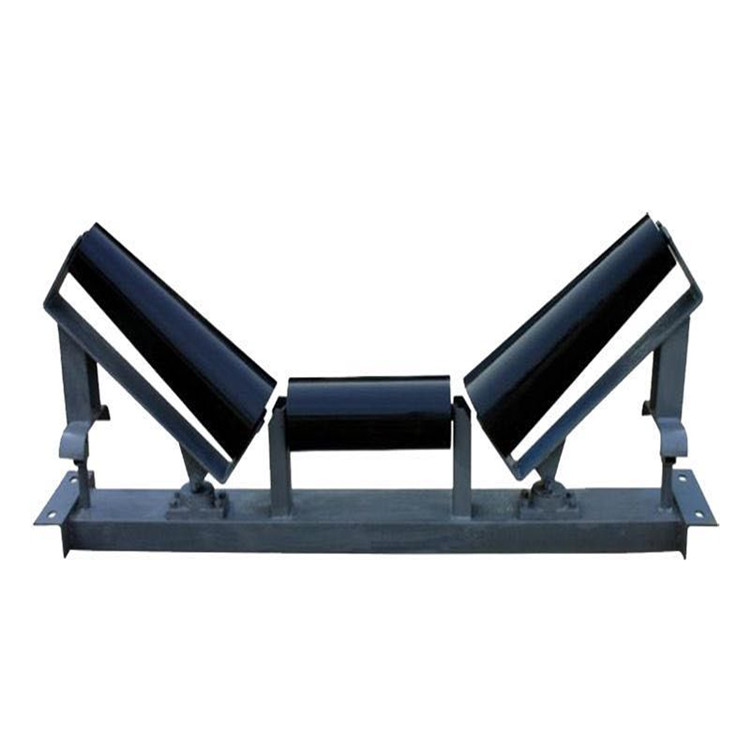
A belt does not stay centred by itself. Aligning (self-aligning) idlers are mounted so the roller set can pivot and follow the belt, applying a corrective force when the belt begins to drift. They are placed where mistracking risk is highest — typically after the loading point, along long unsupported spans and ahead of the tail pulley. Guide rollers restrict lateral movement at the belt edge in the same zones.
The value of alignment is easiest to see in continuous plant. In cement raw-material handling, stable belt support and correction reduce belt mistracking and maintenance frequency across a 24/7 operation — the same reason ports and bulk terminals specify sealed bearings and corrosion-resistant surfaces for outdoor, humid and salt-spray conditions.
Roller Materials and Construction: What Changes the Behaviour
Material choice changes how a roller behaves in service rather than what it fundamentally does.
- Steel remains the reference material, accounting for 64% of global conveyor roller market share in 2024. It suits standard and heavy-duty carrying positions where structural strength and wear life matter most.
- Rubber-ring construction is used where impact energy must be absorbed, as in the 8020 impact roller's carbon steel tube with wear-resistant rubber rings.
- HDPE and nylon shells are used where priorities shift towards lighter weight, corrosion resistance or lower noise — considerations that appear in specialised niches such as low-noise HDPE rollers in mining and in humid, salt-spray environments.
Sealing is the quieter variable. In dusty, heavy-duty conditions the requirement is dust-resistant seals combined with low rotational resistance and wear resistance, because a seal that admits fines converts a low-friction roller into a braked one. The bearings inside the roller are what reduce rotation resistance in the first place, so their protection determines whether the mechanism still works after the first thousand hours.
Step-by-Step: Mapping Idler Roles Along a Conveyor Line
Selecting idlers is a sequence, not a shopping list. The following order keeps the mechanism — support, trough, impact, alignment — aligned with the structure of the line.
- Split the line into zones. Loading point, carrying run, transition, return run and tail or take-up. Each zone has a different dominant load.
- Confirm the engineering inputs. Belt width, belt speed, load, trough angle, environment and installation dimensions define what the rollers must do before any model is chosen.
- Set the carrying idlers. Select the trough angle (20°, 25° or 35°) against capacity and belt width, then confirm dimensions and load ratings against CEMA 502-2022 or the governing project standard.
- Define the loading point duty. Place impact rollers under the loading point and crusher discharge, where material velocity and lump size create the highest shock loads.
- Support the return strand. Return and flat rollers hold the empty belt on its way back; they carry far less load but set the belt's running attitude.
- Add alignment where drift starts. Place aligning or self-aligning idlers after the loading point and along long spans rather than distributing them evenly by habit.
- Check the standards that govern the order. DIN 22112 Part 3 for underground coal mining idler testing, CEMA 502-2022 for troughing and return idler dimensions and load ratings, GB/T 10595 where it applies, and ISO 5048:1989 for power and tension calculations in belt conveyors with carrying idlers.
- Validate before mass production. Sample approval, first-article inspection and batch sampling inspection confirm that the roller delivered matches the roller specified.
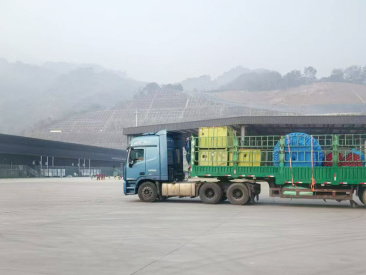
Idler Roles at a Glance
| Idler role | Position on the line | Primary function | Belt contact | Typical duty |
|---|---|---|---|---|
| Parallel idler roller | Flat carrying sections, return strand | Hold the belt with low-resistance flat support | Flat, roller axis parallel to belt width | Standard to light |
| Trough idler (20° / 25° / 35°) | Carrying run | Shape the belt into a trough to contain bulk material | Three-roll troughing set at the selected angle | Standard to heavy |
| Impact roller | Loading point, crusher discharge | Absorb material impact and protect belt and bearings | Rubber-ring shell on a carbon steel tube | High impact, heavy duty |
| Self-aligning / aligning idler | After loading points, long spans | Return a drifting belt to the centre line | Pivoting troughing or flat set | Corrective |
| Return roller | Return run | Support the empty return belt | Flat | Light |
Table entries describe functional roles. Final selection depends on belt width, belt speed, load, trough angle, environment and installation dimensions.
Where These Roles Matter Most
Mining. Ore conveyor lines run 24/7 in dusty, heavy-duty conditions where the belt must be supported continuously and must absorb impact at the loading point. Requirements cluster around dust-resistant seals, low rotational resistance and wear resistance, with parameters set by the operating conditions.
Cement. Raw-material handling lines combine heavy dust with medium-to-high temperatures. The measurable benefit of correct idler roles here is stability: fewer mistracking events and lower maintenance frequency across continuous operation.
Ports and bulk logistics. Outdoor, humid, salt-spray conditions over long conveying distances change the priority order. The return belt must stay smooth-running, so corrosion-resistant surfaces, sealed bearings and low noise move to the front.
Quarrying. Alongside mining, quarrying forms a large part of idler demand, and the duty profile is similar: impact at the feed, abrasive material in the trough, and continuous operation that punishes any idler resisting rotation.
Standards and Verification Behind a Reliable Roller
Reliability in this category is documented rather than claimed. Four references structure most idler specifications: DIN 22112 Part 3 (1996) for testing requirements of belt conveyor idlers used in underground coal mining; CEMA Standard No. 502-2022 for dimensional standards and load ratings of bulk material belt conveyor troughing and return idlers; GB/T 10595, applied subject to project requirements; and ISO 5048:1989 for power and tension calculation in belt conveyors with carrying idlers.
Behind the standards sits inspection scope. A material and inspection report issued per batch typically covers material, dimensions, radial runout, rotational resistance and appearance, and can be issued internally or through a third party depending on the order. Production inspection covers incoming material, dimensional checks, radial runout, rotational resistance, noise and appearance, while pre-shipment inspection verifies appearance, dimension, performance, quantity and packaging.
Shanghai Eastrise Trading Co., Ltd. is a foreign-trade enterprise headquartered in Shanghai, China, focused on supplying mining accessories — rubber conveyor belts, conveyor idlers and rollers, pulleys and drums, high-pressure rubber hoses and pipe connectors — with self-operated manufacturing factories integrating R&D, production, quality testing and export. The company holds ISO 9001:2015 certification through the China Quality Center covering design, procurement, production and quality management, operates an 11,000 m² factory with 50 employees, and reports 2,000 t of annual production capacity with an export share of 20%.
Frequently Asked Questions
Which standards apply to conveyor idler rollers?
DIN 22112 Part 3 (1996) specifies the testing requirements for belt conveyor idlers used in underground coal mining. CEMA Standard No. 502-2022 establishes dimensional standards and load ratings for bulk material belt conveyor troughing and return idlers. GB/T 10595 is used alongside these for the relevant projects. For design calculations, ISO 5048:1989 covers the calculation of power and tension in belt conveyors with carrying idlers. Which document governs a specific order depends on the project — the material and inspection report issued by Shanghai Eastrise Trading Co., Ltd. lists DIN 22112 / CEMA / GB/T 10595, subject to project requirements.
How do you identify the most reliable conveyor roller manufacturers?
Reliability is usually visible in documentation rather than in claims. Four checks are useful: whether the supplier states which standards it works to, such as DIN 22112, CEMA and GB/T 10595; whether the inspection scope is defined, covering material, dimensions, radial runout, rotational resistance and appearance; whether inspection takes place at sample approval, first-article and batch sampling stages; and whether customization depth is specified — tube diameter, shaft diameter, length, seals, bearings, surface treatment, logo and packaging. Operating evidence matters as well: an 11,000 m² factory, 50 employees, 10 engineers and 2,000 t of annual output describe production scale, while a mining contractor project of 100,000 units per year over two years in global mining operations describes field performance under heavy-load conditions.
What sets the minimum order quantity and cost of a conveyor roller?
Duty and customization dominate. Duty decides whether a standard idler or a rubber-ring impact roller is required — an impact roller such as the 8020 model is specified for loading points, crusher discharge and heavy-duty conveyors, while parallel, trough and return rollers cover the supporting runs. Customization — tube diameter, shaft diameter, length, seals, bearings, surface treatment, logo and packaging — determines tooling and batch setup. Minimum order quantities are quoted per production mode: private label from 100 pcs, engineering-support orders from 50 pcs with negotiation for large-scale projects, and OEM/ODM from 10 units.
Can conveyor rollers be validated before mass production?
Yes, and the sequence is fixed: sample approval, then first-article inspection, then batch sampling inspection. Samples for OEM/ODM configurations are typically produced in 5–7 days. Before shipment, appearance, dimension, performance, quantity and packaging are inspected, and a material and inspection report is generated per batch covering material, dimensions, radial runout, rotational resistance and appearance.
How long does a conveyor roller order take to produce?
Lead time depends on the production mode. Private-label orders are quoted at 30–45 days upon order confirmation. Engineering-support orders list drawing confirmation at 3–5 business days with mass production at 30–45 days. OEM/ODM orders list 5–7 days for samples and 15–30 days for mass production, with remote technical support and spare-parts recommendations after delivery. Lead times assume confirmed drawings, so the fastest route to a quotation is a belt width, belt speed, trough angle and installation dimension rather than a product name alone.
Conclusion: Support First, Then Selection
Conveyor rollers drive material transport by not resisting it. Bearings reduce rotation resistance, shell-to-belt friction turns the roller, and the driven belt converts that rotation into continuous linear movement of the material above it. Every idler role on a line protects one part of that sequence: parallel idler rollers hold the belt flat, trough idlers at 20°, 25° or 35° shape the load, impact rollers absorb the loading point and crusher discharge, and aligning idlers keep the belt centred so the belt is never fighting the structure.
Choose the roles from the operating inputs — belt width, belt speed, load, trough angle, environment and installation dimensions — then verify them against DIN 22112 Part 3, CEMA 502-2022, GB/T 10595 and ISO 5048:1989 as the project requires.
Next step
Send the belt width, belt speed, trough angle and installation dimensions, and Shanghai Eastrise Trading Co., Ltd. will return a suggested idler configuration, a quotation, or a sample for validation. OEM/ODM samples are typically available in 5–7 days.
Website: www.sh-eastrise.com | Email: jone.liu@sh-eastrise.com | Tel / WhatsApp: +86 18516552763
Download the product brochure and specification sheet: Eastrise product brochure (PDF)
Have Questions or Need More Details?
Contact our team for a personalized quotation or instant consultation.
Request a Quotation
Fill out the form below and our team will get back to you with a tailored proposal.
WhatsApp Direct Chat
Prefer to chat in real-time? Message us on WhatsApp for instant assistance & quick answers.
- Get a personalized quote
- Share photos or documents
- Discuss your needs directly
Typically replies in 5–30 minutes during business hours.