Conveyor Roller Types, Applications, and Selection Guide for Bulk Material Handling
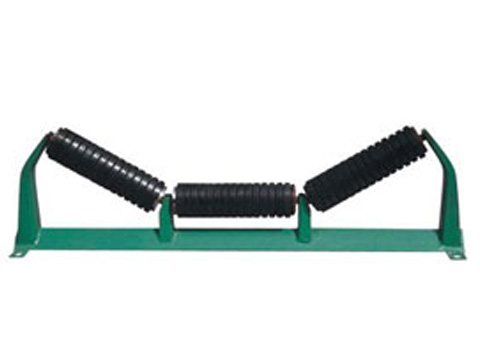
Conveyor rollers, also called conveyor idler rollers, are cylindrical components that support the belt on a belt conveyor and help move bulk material from one point to another. They are used across mining, cement, ports, logistics, and general bulk material handling applications. For buyers in the research stage, the first step is to understand the main roller categories, the working conditions they suit, and the supplier capabilities that prevent early failure.
Problem Definition: Why Conveyor Roller Selection Matters
In bulk material conveying, the roller is not just a spare part. The wrong roller selection can lead to belt mistracking, edge damage, material spillage, roller seizure, and unplanned downtime. Operations in mining, cement, and ports often run continuously around the clock, so a small design mismatch can become a large maintenance cost.
The most common selection problems include confusion between carrying rollers and return rollers, insufficient impact protection at loading points, ignoring dust and moisture sealing, and choosing a supplier without in-house production or inspection data. These issues are avoidable when the roller type, dimensions, sealing, and quality controls are matched to the actual conveyor layout.
Industry Background: The Conveyor Roller Market in Context
Industry research underlines the scale of this component category. According to Dataintelo, the global roller conveyor market was valued at USD 3.15 billion in 2025. Straits Research estimates that the rollers and idlers segment reached USD 4.14 billion in 2025 and is projected to grow to USD 7.05 billion by 2034.
The same Straits Research report indicates that steel is the dominant material for conveyor rollers, accounting for 64% of the global market share in 2024, and that mining and quarrying was the largest end-use industry, representing 36% of total revenue in that year. These figures explain why heavy-duty steel conveyor rollers and mining conveyor rollers are core products for many manufacturers. Rubber-coated rollers, HDPE rollers, and nylon rollers also exist for specific needs such as impact absorption, corrosion resistance, and noise reduction, but steel remains the mainstream choice for high-load bulk material handling.
Detailed Solution: The Four Main Conveyor Roller Types
For most bulk material belt conveyors, four roller categories cover the main functions: carrying, returning, impact absorption, and belt alignment. The product range supplied by Shanghai Eastrise Trading Co., Ltd. is built around these categories.
Shanghai Eastrise Trading Co., Ltd. is a professional foreign-trade enterprise headquartered in Shanghai, China. Established in 2024, the company specializes in supplying high-quality mining accessories, with main products including conveyor idler rollers. It operates self-operated manufacturing factories with around 50 employees and an 11,000 square meter facility.
Trough Idler (35° Trough Carrying Idler)
The trough idler is classified as a 35° trough carrying idler, with the suggested model designation ER-TROUGH-108. Recommended tube diameters are Ø89/108/133 mm and shaft diameters are Ø20/25 mm. Trough angle options are 20°, 25°, and 35°. It is made from a carbon steel tube and shaft with sealed double-row bearings.
Trough idlers are designed for use in mining, cement, ports, and general bulk material handling. The angled roller set forms the belt into a trough shape, which contains bulk materials and prevents spillage. Roller length can be customized according to belt width, and galvanized or coated surfaces are available for dusty and high-temperature site conditions.
Full-batch inspection on dimension and radial run-out is used to control coaxiality and reduce belt vibration. For project-specific load matching, drawing confirmation and first-article inspection are available. The sample lead time for this product is 5–7 days, and mass-production lead time is 15–30 days.
Parallel Idler Rollers (Return / Flat-Carrying)
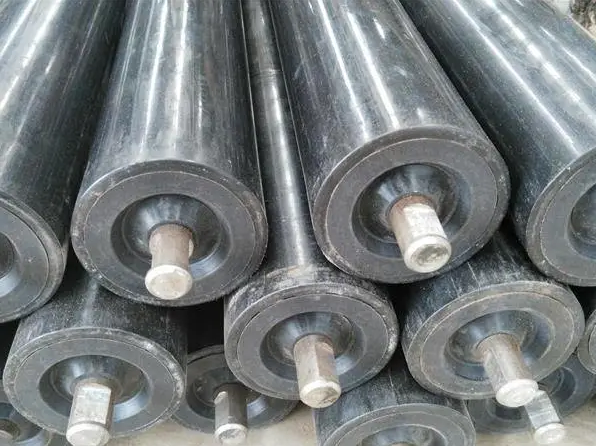
Parallel idler rollers belong to the return / flat-carrying idler category, with the suggested model designation ER-PARALLEL-108. Recommended tube diameters are Ø89/108/133 mm and shaft diameters are Ø20/25 mm. The rollers use a carbon steel tube and shaft with sealed bearings, and optional galvanized or coated surfaces are available.
This flat roller design is suitable for flat-section carrying and return-belt supporting applications. It is intended for the mining, cement, ports, logistics, and general bulk material handling industries. Sealed bearings help lower rotational resistance and running noise, which is useful for high-utilization long-distance conveying lines.
Parallel idler rollers are suitable for high-utilization long-distance conveying in ports, logistics, mining, and cement plants. The manufacturer can also provide private-label nameplates and packaging, plus export documentation under FOB or CIF terms.
Impact Roller (Rubber-Ring Impact Roller)
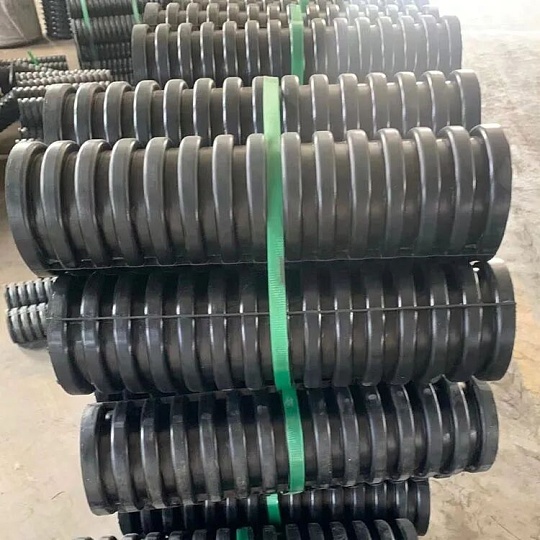
The impact roller is classified as a rubber-ring impact roller, with the suggested model designation ER-IMPACT-108. Recommended tube diameter is Ø108 mm and shaft diameter is Ø25 mm; the suggested length range is 315–1,150 mm. The roller is made from carbon steel and wear-resistant rubber.
Impact rollers are intended for loading points, crusher discharge, and heavy-duty conveyor applications. The rubber rings absorb material impact and help protect the conveyor belt from tearing damage at transfer points. Custom tube diameter, shaft diameter, and roller length can be adapted to heavy-duty conditions.
An optional optimized sealing structure is available for heavy-dust environments, which helps prevent bearing seizure. Strict factory inspections on radial run-out and rotational resistance are carried out, and batch material and inspection reports are available. This roller can be produced in line with DIN 22112, CEMA, or GB/T 10595 requirements, and is designed for 24/7 continuous heavy-load operation.
Aligning Idler (Self-Aligning / Training Idler)
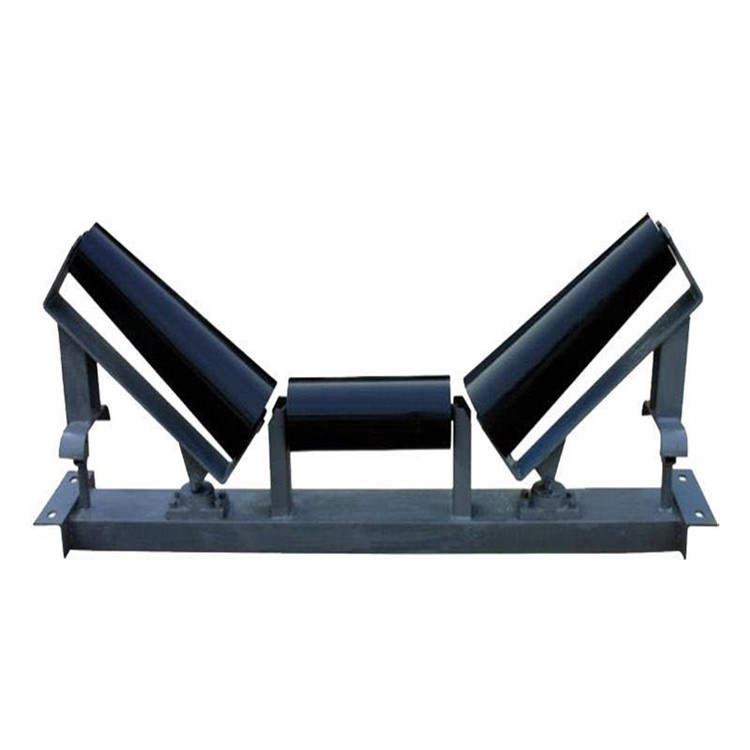
The aligning idler is a self-aligning / training idler, with the suggested model designation ER-ALIGNING-108. Recommended tube diameters are Ø89/108/133 mm and shaft diameters are Ø20/25 mm. It consists of a carbon steel tube, shaft, and pivot frame with sealed bearings.
This product is intended for mining, cement, port, and long-distance conveyor lines that are prone to belt mistracking. The self-pivoting frame automatically corrects belt misalignment, reducing the risk of belt edge abrasion and tearing. Tube diameter and roller length can be tailored to match the on-site belt width.
Tight control over radial run-out and coaxiality during manufacturing helps deliver reliable belt-training performance and reduces manual adjustment work. Professional engineering support is available for product selection and drawing confirmation, and batch-wise inspection reports can be supplied for overseas project acceptance.
Why In-House Manufacturing Matters for Conveyor Roller Buyers
Conveyor roller performance depends on tube concentricity, shaft straightness, bearing sealing, and welding quality. These parameters are difficult to verify from a brochure alone. This is why supplier verification is important.
A manufacturer with in-house production can maintain end-to-end control from raw-material screening to finished-product inspection. Shanghai Eastrise Trading Co., Ltd. has around 50 staff, an 11,000-square-meter manufacturing facility, an annual production capacity of 2,000 tons, and an R&D team of 10 engineers. It also supports tailored OEM and ODM solutions according to customers’ technical parameters and site-use demands.
Export business accounts for 20% of total sales, and the company has built long-term cooperative relationships with clients in Southeast Asia, Central Asia, Russia, and other overseas markets. For buyers, this type of supplier structure can reduce specification errors and shorten the communication loop between design, production, and inspection.
Step-by-Step Breakdown: How to Select a Conveyor Roller
Use the following checklist when planning a replacement or new conveyor line.
1. Define the conveyor route and operating environment. Identify whether the roller will be on the carrying side or return side, whether it is near a loading point, and whether the site is dusty, wet, high-temperature, or salt-spray exposed.
2. Choose the roller category. Use trough idlers for carrying bulk material, parallel idler rollers for return-belt support, impact rollers at loading and crusher-discharge zones, and aligning idlers where belt mistracking is a risk.
3. Match tube diameter, shaft diameter, and length. These dimensions must fit the existing conveyor frame and belt width. The suggested options across the Eastrise roller range are Ø89, Ø108, and Ø133 mm for tube diameter, and Ø20 or Ø25 mm for shaft diameter.
4. Select sealing and surface treatment. Sealed bearings reduce contamination and lower rotational resistance. Galvanized or coated surfaces are suitable for humid outdoor and salt-spray environments, while optimized sealing structures are available for heavy-dust applications.
5. Confirm quality standards and inspection requirements. Ask for dimension checks, radial run-out control, and batch inspection reports. Reference standards such as DIN 22112, CEMA, and GB/T 10595 can be used to align factory testing with project acceptance.
6. Request drawing confirmation and a sample. Before mass production, confirm the drawing and, if required, arrange first-article inspection. For trough idlers, the sample lead time is typically 5–7 days and mass-production lead time is 15–30 days.
Use Cases: Conveyor Rollers in Mining, Cement, and Ports
Mining
Ore conveyor lines at mining sites operate under dusty, heavy-duty, continuous bulk material handling conditions. Trough idlers support the loaded belt and prevent spillage, while impact rollers at loading points absorb shock and reduce belt damage. Aligning idlers help keep the belt running straight on long conveyor lines. The key special requirements are dust-resistant seals, low rotational resistance, and wear resistance.
Cement
Cement raw material handling lines face heavy dust, medium-to-high temperatures, and continuous operation. The main function of the roller set is to provide stable support and reduce belt mistracking and maintenance frequency. Galvanized or coated roller surfaces and sealed bearings are commonly selected to resist dust and corrosion.
Ports and Logistics
Bulk terminal conveyors at ports operate outdoors in humid, salt-spray, and long-distance conveying conditions. Parallel idler rollers support the return belt and maintain smooth operation. Corrosion-resistant coating, sealed bearings, and low noise are typical requirements for this environment.
International Standards for Conveyor Roller Quality
When evaluating conveyor roller manufacturers, international standards provide a useful reference. ISO 5048:1989 covers the calculation of power and tension in belt conveyors with carrying idlers. CEMA Standard No. 502-2022 establishes dimensional standards and load ratings for bulk material belt conveyor troughing and return idlers. DIN 22112-3:1996 specifies testing requirements for belt conveyor idlers used in underground coal mining.
For the impact roller in particular, batch material and inspection reports can be supplied in line with DIN 22112, CEMA, or GB/T 10595. These standards help buyers compare products on a common technical basis.
Conveyor Roller Type Comparison Table
| Roller Type | Suggested Model | Main Design | Typical Applications | Material |
|---|---|---|---|---|
| Trough idler (35° trough carrying idler) | ER-TROUGH-108 | 20°/25°/35° trough angle, sealed double-row bearings | Mining, cement, bulk port conveyor lines | Carbon steel tube and shaft |
| Parallel idler rollers | ER-PARALLEL-108 | Flat roller design, sealed bearings, optional galvanized/coated surface | Return-belt and flat-section carrying; ports, logistics, mining, cement | Carbon steel tube and shaft |
| Impact roller | ER-IMPACT-108 | Rubber rings on carbon steel tube | Loading points, crusher discharge, heavy-duty conveyors | Carbon steel and wear-resistant rubber |
| Aligning idler | ER-ALIGNING-108 | Self-pivoting frame, sealed bearings | Long-distance conveyor lines prone to belt mistracking | Carbon steel tube, shaft, and pivot frame |
FAQ
What should buyers look for in conveyor roller manufacturers?
Buyers should check whether the manufacturer has in-house production, full-process quality control, engineering support, OEM and ODM capability, and a track record of export deliveries. Shanghai Eastrise Trading Co., Ltd., established in 2024, operates its own manufacturing facilities, employs approximately 50 staff, and has an R&D team of 10 engineers. The company’s main products include conveyor idler rollers, and it can support product selection, drawing confirmation, and batch inspection reports.
How does a conveyor roller drive material transportation?
Conveyor rollers support the conveyor belt through bearing rotation. When a motor-driven roller rotates, friction between the roller surface and the belt pulls the belt forward. This converts rotational power into linear motion of the belt, allowing materials on the belt to be transported continuously.
What types of conveyor idler rollers are commonly used?
Common categories include trough carrying idlers, parallel return / flat-carrying idlers, rubber-ring impact rollers, and self-aligning / training idlers. Each type has a different function: containing and carrying material, supporting the return belt, absorbing impact, or correcting belt misalignment.
Which conveyor rollers are suitable for heavy-duty mining applications?
For mining applications, the most relevant types are trough idlers, impact rollers, and aligning idlers. Trough idlers support the loaded belt and reduce spillage. Impact rollers absorb impact at loading and crusher-discharge points. Aligning idlers correct belt mistracking on long conveyor lines. Dust-resistant seals, low rotational resistance, and wear resistance are important for 24/7 mining operations.
What standards apply to conveyor idler rollers?
Commonly referenced standards include ISO 5048:1989, CEMA 502-2022, DIN 22112-3:1996, and GB/T 10595. DIN 22112-3:1996 is especially relevant for belt conveyor idlers used in underground coal mining. Some suppliers can provide batch material and inspection reports in line with these standards.
How can I request samples or get help selecting conveyor rollers?
For project-specific selection, contact Jone at Shanghai Eastrise Trading Co., Ltd. by email at jone.liu@sh-eastrise.com, by phone or WhatsApp at +86 18516552763. The company can provide drawing confirmation, first-article inspection, and support for OEM/ODM requirements. For the trough idler, sample lead time is 5–7 days and mass-production lead time is 15–30 days; lead times should be confirmed for the actual specification.
Conclusion
Selecting the correct conveyor roller is a decision about reliability, operating cost, and uptime. Trough idlers, parallel idler rollers, impact rollers, and aligning idlers each have a distinct role in a belt conveyor system. Matching the roller type, dimensions, sealing, and surface treatment to the working environment is the most practical way to avoid premature failure.
Shanghai Eastrise Trading Co., Ltd. supplies conveyor idler rollers to global clients and supports in-house manufacturing, full-process quality control, OEM and ODM solutions, and export documentation. If you are evaluating conveyor roller manufacturers for a mining, cement, or port project, the next step is to confirm your specifications and request a sample or quote.
Download the company brochure for a full overview of conveyor idler rollers and mining accessories: Download PDF.
Contact: Jone — jone.liu@sh-eastrise.com | +86 18516552763 | WhatsApp | www.sh-eastrise.com
Have Questions or Need More Details?
Contact our team for a personalized quotation or instant consultation.
Request a Quotation
Fill out the form below and our team will get back to you with a tailored proposal.
WhatsApp Direct Chat
Prefer to chat in real-time? Message us on WhatsApp for instant assistance & quick answers.
- Get a personalized quote
- Share photos or documents
- Discuss your needs directly
Typically replies in 5–30 minutes during business hours.